When purchasing quartz glass tubes, choosing the right size and specification is just as important as selecting a reliable manufacturer. The dimensions of a quartz tube can directly affect its installation, performance, durability, and suitability for a particular application.
Quartz glass tubes are available in many different diameters, wall thicknesses, and lengths. For special applications, manufacturers can also produce customized quartz tubes according to drawings, samples, or specific technical requirements.
This guide explains the key quartz glass tube specifications you should consider before placing an order.
1.What Are the Main Quartz Glass Tube Dimensions?
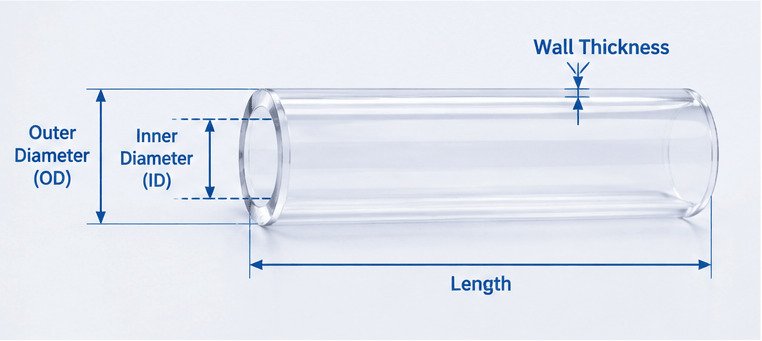
The most important dimensions of a quartz glass tube usually include:
- Outer diameter (OD)
- Inner diameter (ID)
- Wall thickness
- Tube length
- End configuration
- Tolerance requirements
Understanding these specifications can help you communicate your requirements clearly with a quartz glass tube manufacturer.
Outer Diameter
The outer diameter is the total diameter measured from the outside of the quartz tube.
It is an important specification when the tube needs to fit into another component, chamber, heating system, or piece of laboratory equipment.
For example, if a quartz tube needs to fit into a specific holder, the outer diameter must match the available space.
Inner Diameter
The inner diameter refers to the diameter of the opening inside the quartz tube.
It is especially important when the tube is used to contain materials, allow gas or liquid flow, or accommodate another component.
When ordering quartz tubes, both the inner diameter and outer diameter should be considered because they determine the available internal space and wall thickness.
Wall Thickness
Wall thickness is the distance between the inner and outer surfaces of the quartz tube.
Different applications require different wall thicknesses.
A thinner wall may be suitable for applications where weight and heat transfer are important, while a thicker wall may be preferred when greater mechanical strength or durability is required.
The appropriate wall thickness depends on factors such as temperature, pressure, mechanical conditions, and the intended application.
Length
Quartz glass tubes can be manufactured in different lengths depending on the application and equipment requirements.
Before ordering, it is important to confirm whether the required length refers to the total tube length or the usable length after processing.
For customized quartz tubes, manufacturers can often cut the tube to the required length and perform additional processing when necessary.
2.Why Quartz Tube Size Matters
Choosing the correct quartz tube size is not simply a matter of selecting a diameter.
The dimensions of the tube can influence:
- Installation
- Heat distribution
- Internal volume
- Gas or liquid flow
- Mechanical strength
- Equipment compatibility
- Processing requirements
- Overall service life
For example, a quartz tube used in a high-temperature heating system may have different dimensional requirements from a quartz tube used in laboratory equipment.
Therefore, it is important to select the dimensions according to the actual working conditions rather than choosing a size based only on appearance.
3.Standard Quartz Glass Tubes vs. Custom Sizes
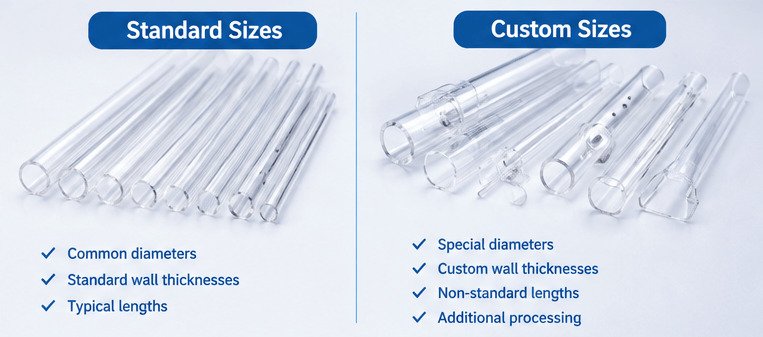
Many quartz glass tube manufacturers offer standard sizes for commonly used applications.
Standard quartz tubes can be a convenient choice when the required dimensions match an existing specification.
However, not every application can use a standard tube.
Some customers may require:
- Special outer diameters
- Specific inner diameters
- Custom wall thicknesses
- Non-standard lengths
- Special end processing
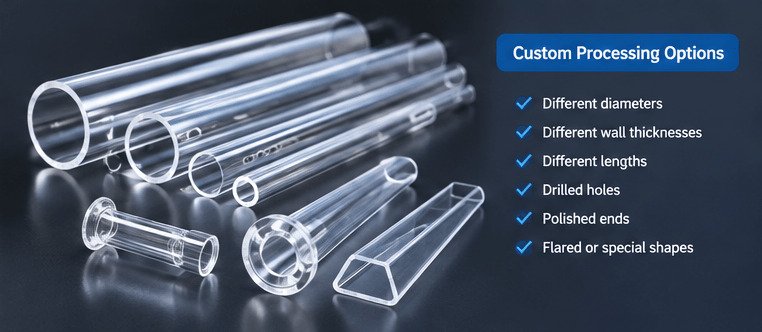
- Drilled holes
- Polished ends
- Flared or other customized sections
In these situations, customized quartz glass tubes may be a better solution.
A professional manufacturer can produce quartz tubes according to technical drawings, samples, or detailed dimensions.
4.How to Choose the Right Quartz Glass Tube Size
Before contacting a manufacturer, it is useful to prepare the following information.
Step 1: Confirm the Outer Diameter
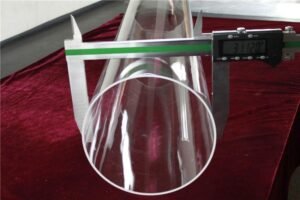
Determine the maximum outside diameter that your equipment or installation can accommodate.
If the tube needs to be installed inside another component, measure the available space carefully.
Step 2: Confirm the Inner Diameter
Consider what needs to pass through or fit inside the quartz tube.
The required inner diameter may depend on the size of the material, component, gas flow path, or other internal equipment.
Step 3: Determine the Wall Thickness
Wall thickness should be selected based on the operating environment.
Consider factors such as:
- Operating temperature
- Mechanical stress
- Pressure conditions
- Heating and cooling cycles
- Installation requirements
For demanding applications, it is recommended to discuss the required wall thickness with the manufacturer.
Step 4: Confirm the Length
Provide the required overall length and specify whether additional processing will be performed on the tube.
For example, a tube may need to be cut into several shorter sections or have its ends processed after cutting.
Step 5: Check Tolerances
For applications requiring precise installation, dimensional tolerances may be important.
Instead of only providing nominal dimensions, customers should communicate the acceptable tolerance range when precision is critical.
A manufacturer can then determine whether the requested tolerance can be achieved with the available production and processing methods.
5.Quartz Tube Dimensions for Different Applications
Different industries may have different requirements for quartz tube dimensions.
Laboratory Equipment
Laboratory quartz tubes are often selected based on equipment compatibility, internal volume, and experimental requirements.
Both the tube diameter and length may need to match existing laboratory equipment.
Heating Equipment
Quartz tubes used in heating systems need to be compatible with the heating chamber and operating temperature.
Wall thickness, diameter, and length can all affect installation and performance.
UV Lamp Applications
Quartz glass is widely used in UV-related applications because of its optical properties.
The dimensions of the quartz tube need to match the lamp design and surrounding components.
Solar and Photovoltaic Equipment
Quartz components are also used in solar and photovoltaic manufacturing equipment.
These applications may require specific dimensions, high-quality surfaces, and consistent production tolerances.
Industrial Equipment
Industrial applications may require larger quartz tubes or customized dimensions.
In these cases, working conditions and equipment design should be considered when selecting the tube size.
6.What Information Should You Send to a Quartz Glass Tube Manufacturer?
When requesting a quotation, providing complete specifications can help the manufacturer understand your requirements and provide a more accurate price.
A typical inquiry should include:
Product: Quartz Glass Tube
Outer Diameter: XX mm
Inner Diameter: XX mm
Wall Thickness: XX mm
Length: XX mm
Quantity: XX pieces
End Processing: If required
Application: Optional
Drawing or Sample: If available
For example:
Quartz glass tube
OD: 50 mm
ID: 44 mm
Wall thickness: 3 mm
Length: 500 mm
Quantity: 100 pieces
Providing this information can make communication faster and reduce the possibility of specification errors.
7.Can Quartz Glass Tubes Be Customized?
Yes. Quartz glass tubes can be customized for many different industrial and laboratory applications.
Depending on the manufacturer’s capabilities, customization may include different diameters, wall thicknesses, lengths, and additional processing.
For customers with non-standard requirements, a technical drawing or physical sample can be particularly helpful.
A manufacturer can review the requirements and determine the appropriate production method.
8.Why Work With a Quartz Glass Tube Manufacturer?
Buying directly from a manufacturer can provide several advantages when customized or repeat orders are required.
A professional manufacturer can help customers:
- Confirm suitable dimensions
- Review technical drawings
- Produce customized sizes
- Maintain consistent specifications
- Provide stable supply
- Arrange additional processing
- Support repeat production
For industrial customers, consistent dimensions and stable quality are particularly important when quartz tubes are used as part of larger equipment or production systems.
9.Final Checklist Before Ordering Quartz Glass Tubes
Before placing an order, check the following specifications:
☑ Outer diameter
☑ Inner diameter
☑ Wall thickness
☑ Length
☑ Dimensional tolerance
☑ End processing
☑ Quantity
☑ Material requirements
☑ Application requirements
☑ Drawing or sample, if available
Providing complete information helps the manufacturer understand your requirements and reduces unnecessary communication during the quotation and production process.
Conclusion
Choosing the right quartz glass tube size requires more than simply selecting a diameter. Outer diameter, inner diameter, wall thickness, length, tolerance, and processing requirements should all be considered according to the actual application.
For standard applications, an existing quartz tube specification may be sufficient. For specialized equipment or unusual dimensions, customized quartz glass tubes can provide a better fit.
If you already know the required dimensions, you can provide the outer diameter, inner diameter, wall thickness, length, quantity, and any processing requirements to a quartz glass tube manufacturer for evaluation and quotation.
If you need customized quartz glass tubes, contact us with your specifications, drawings, or samples. We can review your requirements and provide a suitable solution for your application.